
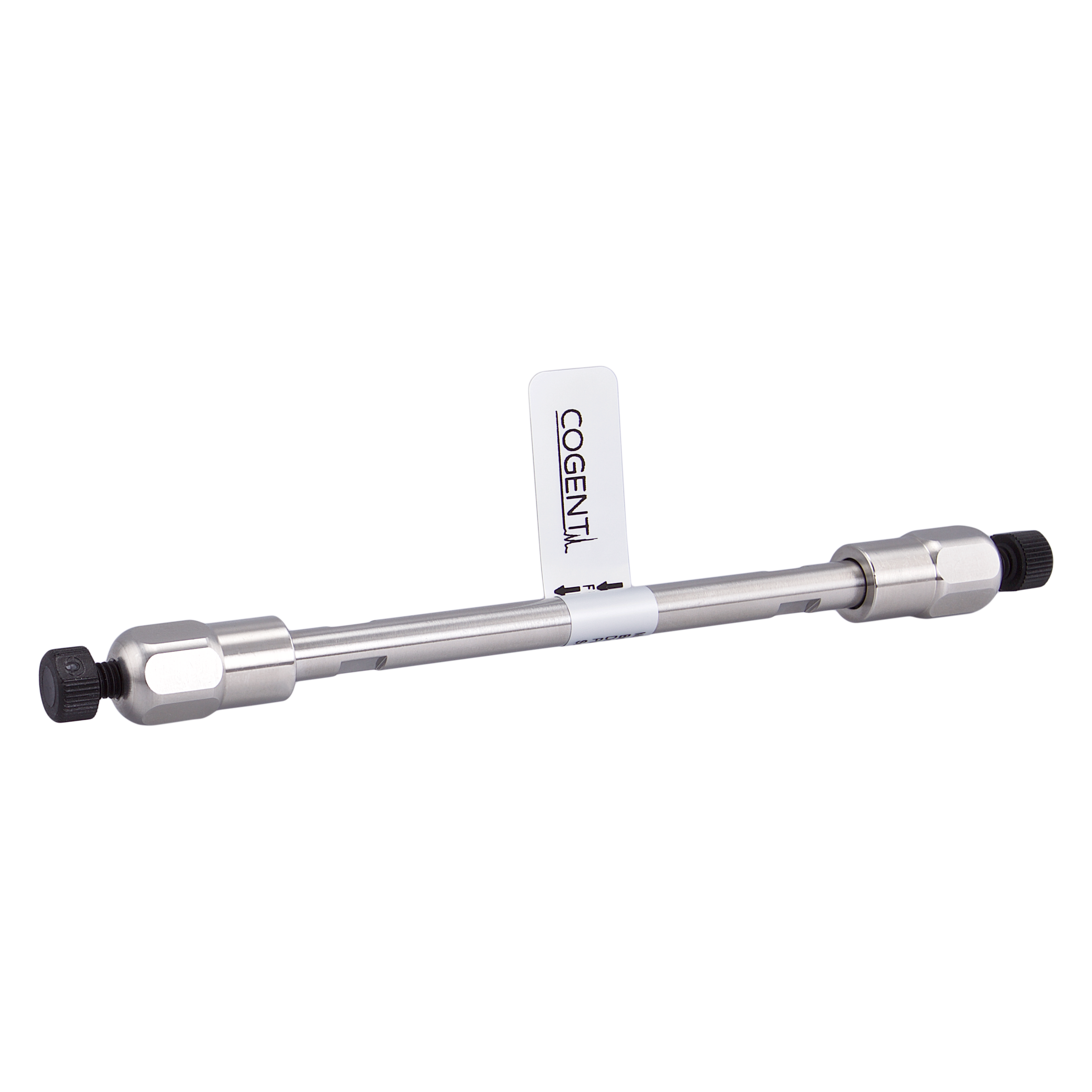
HPLC Column, RP PFP, 5um, 2.1mm ID x 100mm Length, 60A. Cogent Brand. 1 EA.
Additional Information:
60022-10P-2 Cogent RP PFP™ HPLC Column has been a premium value trusted by HPLC laboratories for many years, delivering consistent performance and enhanced selectivity for challenging separations. This column is fully double end‑capped and bonded via a four‑carbon linker to a benzene ring substituted with five fluorine atoms, using ultra‑high purity silica.
The column provides multiple retention mechanisms—including π‑π interactions, dipole interactions, and hydrogen bonding—making it highly effective for halogenated, aromatic, and polar analytes. It is also suitable as an alternate column for USP methods requiring L43 classification.
With a 5 µm particle size, this column offers lower backpressure compared to smaller particle columns, allowing for improved robustness and compatibility while maintaining strong chromatographic performance.
100 mm Length – Balanced Resolution and Run Time
The 100 mm length provides an ideal balance of resolution and speed, making it suitable for routine analytical methods and method development.
Improved resolution compared to 50 mm columns
Faster run times than longer column formats
Increased peak capacity for moderately complex samples
✅ Recommended for routine LC‑MS workflows and analytical method development
Flow Rate & System Requirements (2.1 mm ID, 5 µm)
⚠️ Designed for low‑flow applications with improved pressure tolerance
Typical flow rate range: ~0.2 – 0.4 mL/min
Lower backpressure than 3 µm columns
Compatible with LC‑MS and low‑flow HPLC systems
Improved robustness for routine use
✅ Important: Standard HPLC systems must be capable of stable, accurate low flow rates
✅ Best Practice: Filter samples using a 0.2 µm syringe filter prior to injection
Why Choose PFP (F5) Columns for Selective Separations
Enhanced Retention for Halogenated Compounds
Strong interaction with fluorinated and halogenated analytes
Improved selectivity vs C18 columns
Multiple Interaction Mechanisms
π‑π interactions for aromatic compounds
Dipole and hydrogen bonding interactions
Greater flexibility for method development
60 Å Pore Structure
Optimized for small molecule separations
Efficient interaction for lower molecular weight analytes
Cogent RP PFP™ Column Advantages
Fully End‑Capped Surface
Minimizes silanol activity
Improves peak symmetry
Robust Performance (5 µm Particles)
Lower backpressure vs smaller particles
Stable and reproducible operation
High Purity Silica
Consistent chromatographic results
Reliable run-to-run reproducibility
Typical Applications
Halogenated compound analysis
Aromatic compound separations
Polar analyte retention
LC‑MS workflows
Method development and optimization
USP L43 methods
Important Usage Notes
Packed and shipped in reversed‑phase solvents
Designed for LC‑MS and low‑flow HPLC systems (2.1 mm ID)
Lower backpressure compared to smaller particle columns
Requires accurate low‑flow pump capability
Use 0.45 µm filtration prior to injection